


Intent vs Impact
Why It Matters
Most lawyers spend years developing technical expertise, judgement and commercial awareness. Yet one of the strongest predictors of leadership effectiveness is external self-awareness.
External self-awareness is the ability to understand how other people experience you.
It answers questions such as:
How do I come across in meetings?
What is it like to work with me?
Do I create psychological safety or intimidation?
Do clients experience me the way I intend them to?
Does my communication style help or hinder collaboration?
The challenge is that our intentions and our impact are often very different things.
As organisational psychologist Tasha Eurich notes, while many people believe they are self-aware, only a small percentage are genuinely skilled at understanding how others perceive them.
Internal vs External Self-Awareness
Internal Self-Awareness
Understanding:
Your values
Strengths
Weaknesses
Motivations
Emotions
Goals
This is the self-awareness most people focus on.
External Self-Awareness
Understanding:
How others perceive you
The impact you have on others
The behaviours people experience
The emotional climate you create
Most people score strongly on internal self-awareness but can have significant blind spots in external self-awareness. We are human and it’s a skill you can learn.
The Emotional Intelligence Connection
Within Emotional Intelligence, self-awareness is the foundation upon which all other EQ skills are built.
If we don't understand our own impact, it becomes difficult to:
Build trust
Manage relationships effectively
Influence others
Lead teams
Handle conflict constructively
Research consistently shows that those with higher self-awareness tend to demonstrate stronger performance, better relationships and higher levels of team engagement.
The Emotional Intelligence Piece
EQ helps us move from assumptions to observations.
Many lawyers fall into one of two traps:
1.Mind Reading
"They didn't respond for three days. They must be unhappy."
or
"They were quiet in the meeting. I must have done something wrong."
There is usually no evidence for either conclusion.
2.Confirmation Bias
We look for evidence that supports what we already believe.
If we think we're good with clients, we ignore warning signs.
If we worry we're not good enough, we interpret every delayed email as rejection.
External self-awareness requires curiosity rather than assumption.
Ask, "What evidence do I actually have?"
Common Blind Spots for Lawyers
Confidence vs Intimidation
You may believe you are being decisive.
Others may experience you as dismissive.
Efficiency vs Abruptness
You may think you are being direct.
Others may perceive you as impatient or rude.
High Standards vs Perfectionism
You may believe you are maintaining quality.
Others may feel they can never meet your expectations.
Expertise vs Accessibility
You may think you are demonstrating competence.
Others may feel unable to contribute.
None of these are right or wrong.
The point is that impact matters more than intent.
Practical Ways to Improve External Self-Awareness
-
Instead of asking:
"Do you have any feedback for me?"
Try:
"What is it like to work with me?"
"What is one thing I do that helps you perform at your best?"
"What is one thing I could do differently to be more effective?"
Specific questions generate better insights.
-
One piece of feedback may be opinion.
Repeated feedback is data.
Pay attention to recurring themes across colleagues and clients.
-
Feedback is information, not an accusation.
The most effective leaders approach feedback with curiosity:
"Tell me more about that " rather than "That's not what I meant."
Intent explains behaviour.
Impact determines outcomes.
-
Pay attention to:
Who speaks up around you
Who goes quiet
Who challenges you
Who avoids disagreement
People's behaviour often provides valuable information about your leadership impact.
-
Don’t wait for annual reviews.
Seek informal feedback from:
Clients
Peers
Direct reports
Mentors
Trusted colleagues
Small, frequent insights prevent major blind spots from developing.
Where I think external self-awareness becomes most interesting for lawyers…
Many lawyers can't ask clients, "How do I come across?" Particularly if the client is senior, relationship-sensitive, or the lawyer is worried about appearing insecure.
In those situations, external self-awareness becomes less about asking for feedback and more about collecting evidence.
For the lawyers at the start of their career, client interaction may be limited. But getting in the habit of noticing habits and interactions through your team members now, will pay dividends later in your career.
For now, if this doesn’t apply to you, watch for a more senior member of your team.
The Client Clues Framework
Ask yourself:
1.Responsiveness
How quickly does the client respond?
Do they respond directly or delegate?
Have response times changed over time?
A client who feels valued and trusts you often creates more communication, not less.
2. Access
Are they introducing you/ your team to colleagues?
Do they copy you into broader discussions?
Are they inviting you to meetings/ coffees/ drinks where legal advice isn't strictly required?
Access is often one of the strongest indicators of trust.
3. Behaviour During Meetings
Observe:
Do they ask your/ your colleagues opinion on anything?
Do they challenge your thinking?
Do they openly disagree?
Do they engage in conversation with you that’s not work related?
Counterintuitively, disagreement can be a sign of psychological safety. Clients who never challenge you may simply be disengaging.
4. Referrals and Introductions
Clients may never say, "You are doing a great job."
But they will introduce you to colleagues, peers, and contacts.
Behaviour speaks louder than compliments.
A subtle approach is:
"What's most helpful from me when we're working together?"
Most are comfortable answering this because it focuses on service rather than personal criticism.
The answer often reveals:
What they value.
What they notice.
What they wish you did more of.
It's feedback disguised as a service question.
The Most Important Principle
When it comes to any professional relationship, external self-awareness is not necessarily knowing whether they like you.
It's understanding:
How easy am I to work with?
How much trust have I created?
How much value do they experience beyond my technical expertise?
The lawyers with the strongest relationships are often not those with the highest legal IQ. They're the ones who accurately understand other’s experience of working with them and adjust accordingly. That’s external self-awareness in action.
External Self-Awareness for Junior Lawyers
One of the biggest misconceptions about external self-awareness is that it means constantly worrying about what other people think of you.
It doesn't.
In fact, true external self-awareness often involves challenging our assumptions about how others perceive us.
Many junior lawyers fall into what psychologists call the "spotlight effect"—the belief that everyone is paying far more attention to us than they really are.
A delayed email becomes:
"The partner must be unhappy with my work."
A brief response becomes:
"I must have done something wrong."
A challenging question becomes:
"They think I'm not good enough."
The reality is often far less dramatic.
Senior lawyers are usually busy, distracted and focused on solving problems rather than judging junior associates.
The challenge is learning to distinguish between:
What happened.
What story you're telling yourself about what happened.
A Final Thought
When it comes to clients, external self-awareness is understanding:
How easy am I to work with?
How much trust have I created?
How much value do they experience beyond my technical expertise?
Clients rarely tell lawyers why they stay.
They almost never tell lawyers why they leave.
Which is why the ability to read the signals, notice patterns and remain curious about the client's experience becomes such a critical leadership skill.
Most lawyers spend years mastering legal complexity. Far fewer spend time understanding the experience they create for others.
Yet leadership, influence, business development and client loyalty often depend less on what we know and more on how people feel after interacting with us.
The goal is not to become obsessed with other people's opinions.
The goal is to become aware enough to learn, adapt and improve without becoming dependent on external validation.
The most successful lawyers don't spend their careers trying to impress people. They spend their careers understanding the impact they have on people.
That distinction is the foundation of both emotional intelligence and professional growth.
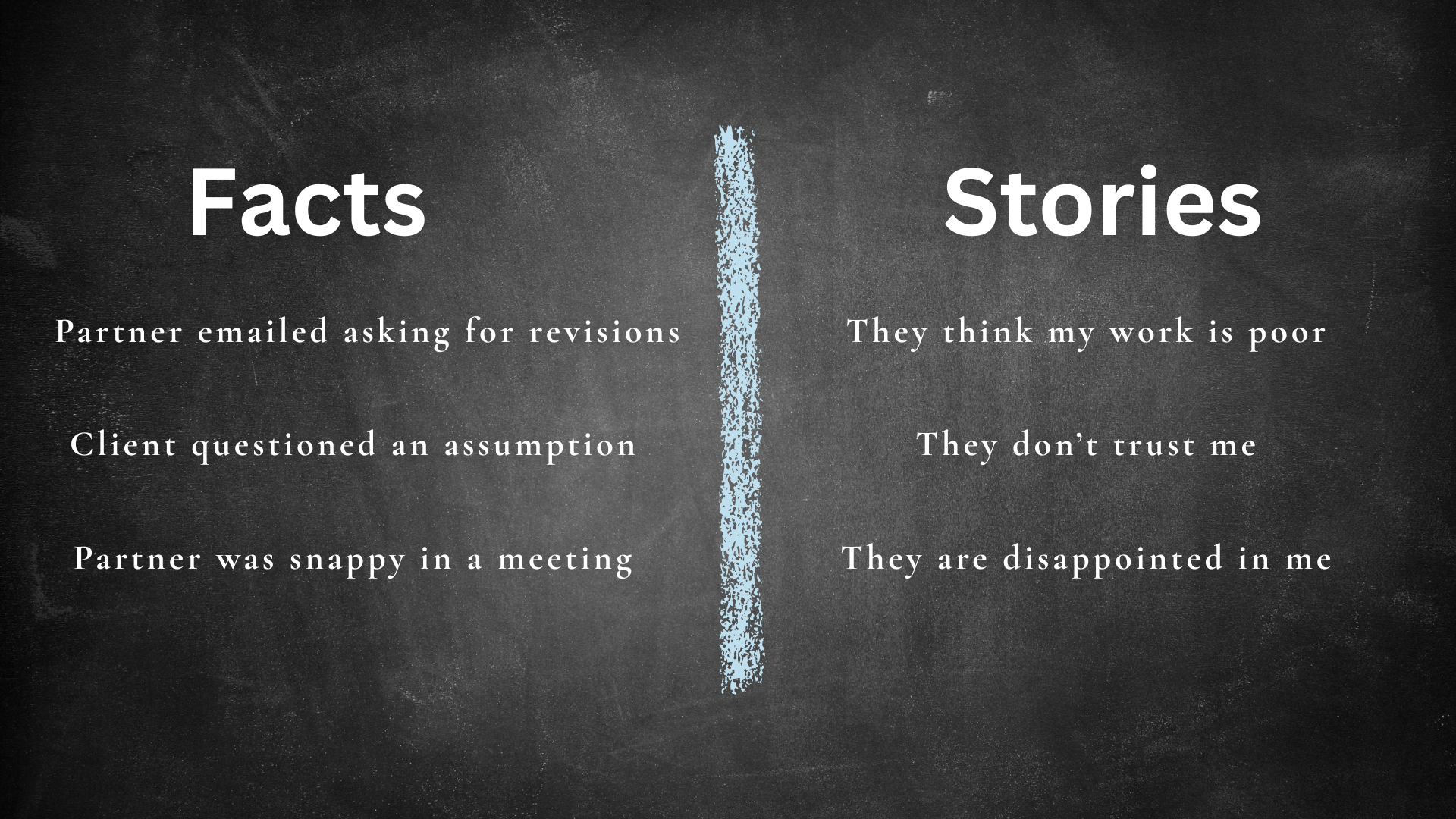
Think about a recent interaction that caused concern or self-doubt, then draw 2 columns, as set out above.
Facts vs Stories.
Now ask:
1. What evidence supports the story?
2. What evidence contradicts it?
3. What are 3 alternative explanations?
This simple exercise helps develop one of the most important emotional intelligence skills: separating observation from interpretation.
The Associate's External Self-Awareness Question
Instead of asking:
"Do they like/trust/ value me?" (delete as appropriate)
Ask:
"What experience am I creating?"
Focus on behaviours you can control:
Am I reliable?
Am I responsive?
Am I curious?
Am I easy to work with?
Do I communicate clearly?
Do I take ownership?
Do I make people's lives easier?
These questions generate growth. And are so important!
The 5-Person Perception Audit
Ask five trusted people:
How would you describe me in 3 words or sentences?
What is the best part of my character?
What is the worst part?
What is one thing I should do more of or less of?
What is one word that describes what it is like to work with me?
The answers are often far more revealing than any personality assessment and create a powerful starting point for improving both emotional intelligence and leadership effectiveness.
The Client Experience Audit
Choose one important client relationship and answer the following questions honestly.
Part 1: The Story I'm Telling Myself
Write down your assumptions.
What do I think this client values most about me?
Why do I think they continue to instruct me?
What do I believe differentiates me from other lawyers they use?
How do I think they would describe me to a colleague?
The aim is to surface your current narrative.
Part 2: The Evidence
Now challenge each assumption.
Ask:
What evidence do I actually have for this?
What behaviours support this belief?
What behaviours might contradict it?
Am I relying on facts or interpretations?
For example:
Assumption: "The client values my responsiveness."
Evidence: They often email me directly and contact me on urgent matters.
Potential Contradiction: They frequently bypass me for strategic discussions.
This step helps separate reality from wishful thinking.
Part 3: Walk Around the Client's Desk
Imagine you are the client and have just finished a year working with you.
Complete these sentences from their perspective:
What I appreciate most about working with you is...
Sometimes I wish you would...
One thing that makes working with you easier than other lawyers is...
One thing that occasionally frustrates me is...
If I could give you one piece of advice it would be...
The goal isn't to be right. The goal is to force yourself out of your own perspective.
Part 4: The Relationship Scorecard
Rate yourself from 1-10 on:
Responsiveness
Commercial understanding
Communication clarity
Proactivity
Ease of working with others
Understanding your clients business
Strategic thinking
Trust
Then ask yourself:
Which score is based on evidence and which is based on ego?